
Spotify – When Does the Music Stop?
Why I believe Spotify has one of the widest moats in media

I recently had lunch with a former colleague of mine and, naturally, we got into a sparring match about stocks (we’re still friends, I think). The one company on which we had a rather robust discussion was Spotify. I’m quite bullish on the business but it was interesting to hear a well-argued bear thesis on Spotify and the durability of its model. The crux of his argument was that Spotify is merely an app, and therefore the moat is narrow.
I argue that Spotify’s moat is much wider, built on personalisation, user habit, and building an ecosystem. It is a business which is critical to the music industry, getting more relevant to more users globally, has inherent pricing power, and an attractive earnings profile which I see compounding at a high-teens rate over the next five years.
The Case Against Spotify
The bear thesis centres upon three core assertions:
Spotify is an effective distribution system for the music industry, but it doesn’t own the underlying content, much of which is commoditised anyways.
It is competing with well capitalised players who bundle music for free.
Its growth is increasingly being driven by lower quality customers in emerging markets.
Combined, these three factors suggest the business has a narrow moat, which makes it inherently difficult to underwrite several years of earnings growth with significant conviction.
A good parallel presented was that of Dropbox (NASDAQ: DBX). Much like Spotify, Dropbox built a superior access and organisation layer on top of content it did not own, it competed with the bundling capabilities of Microsoft and Google, had a margin inflection story and attempted to expand its TAM beyond its core product.
Dropbox grew for many years, maintained strong brand loyalty and reported healthy user metrics well into 2019-2020. However, the decay was gradual. New user acquisition slowed, churn crept up at the margins and growth flatlined. Paying users for Dropbox have now stagnated at around 18m. As a result, the stock has effectively done nothing since the company’s IPO in early 2018 with the multiple continuing to compress despite growing earnings.
These are all valid arguments and more or less true to a certain extent. The question, therefore, is does Dropbox serve as a cautionary tale for Spotify or is there more nuance to the story here?
Curation at Scale
The bear case somewhat reduces Spotify to a pipe that delivers music, and much like a pipe, it assumes that one is no better than another. This may have been true in the early days of the company, but I don’t believe that to be true today.
Notably, Spotify has built the most sophisticated recommendation engine in audio. This is an advantage that continues to compound with time. Every stream, skip, and playlist feeds into a personalisation engine built on 750m+ users and nearly two decades of listening data. This data asset is far from a commodity and almost impossible to replicate. It is the core reason the user experience on Spotify is markedly better than Apple Music, Prime Music or YouTube Music.
Features such as Discover Weekly, Release Radar, AI DJ, and Daily Mixes are powered by the personalisation engine, and this translates to measurable user behaviour. Here are a few statistics:
Users who engage with Daily Mix stream roughly twice as long as users who do not.
One in six (or 48m) Premium users use the AI DJ feature weekly.
Average daily listening time continues to increase, now at 148 minutes per user up from 114 minutes per user.
Recommendation accuracy has improved such that skip rate is down to 28%.
Better personalisation drives higher engagement. Higher engagement results in higher retention. Higher retention drives customer lifetime value and ultimately enterprise value for Spotify. Excess profits are then reinvested back into improving the personalisation of the product and the flywheel continues.
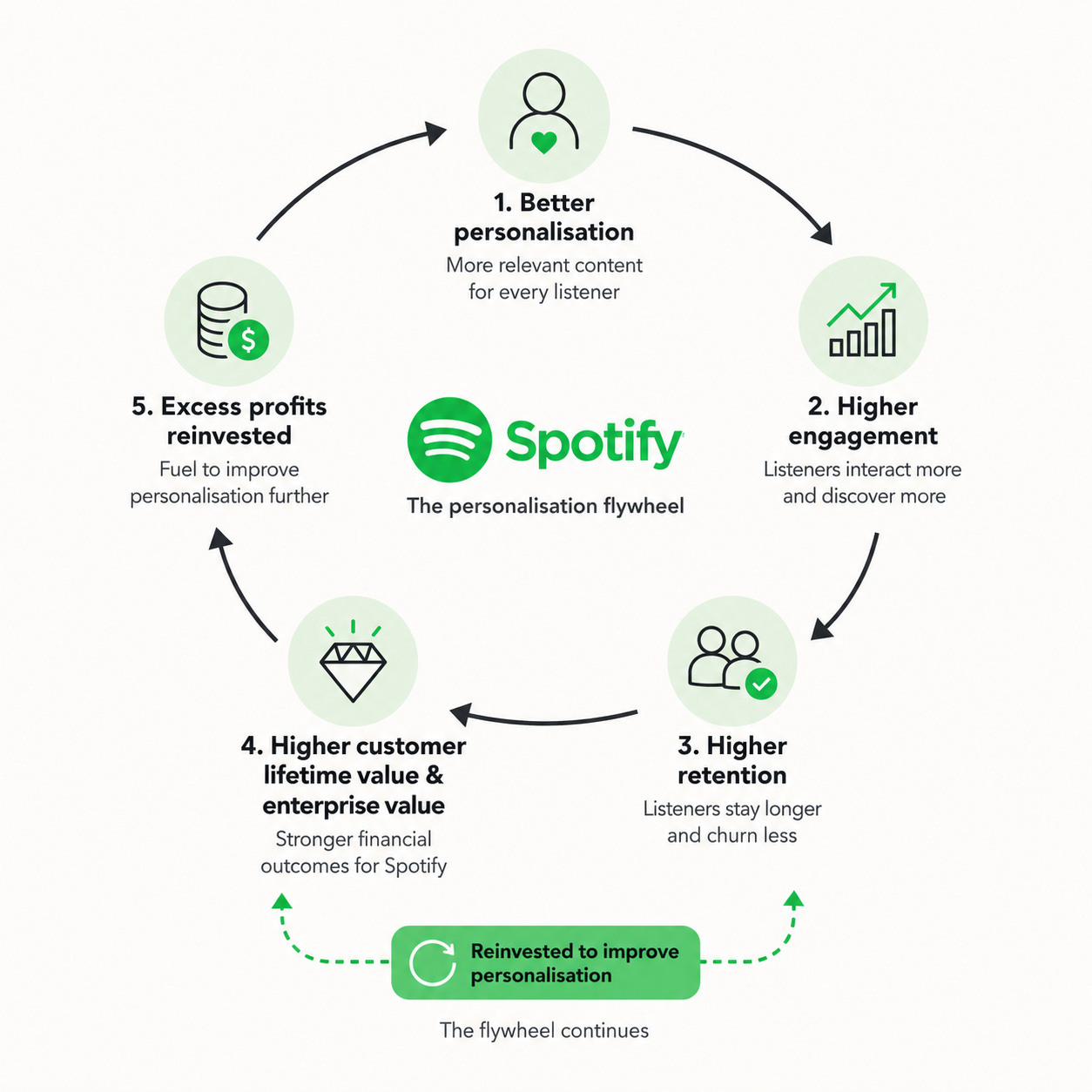
Two decades of learning, iteration, and investment results in the product millions of users around the world enjoy today. And it continues to get better. AI is unlocking even more opportunity for the business to drive engagement on its platform through new features like Prompted Playlists or Personalised Podcasts.
I recognise that product moats erode, and the best product doesn’t always win. The competitive environment also feels especially acute in this case. Apple, Amazon, and Google all want a slice of this market, each brings deep technical talent, ample capital and the ability to bundle music at a loss. But for all three, music is a non-core line and a rounding error against group earnings. It’s hard to outcompete a scaled incumbent like Spotify, that pours every resource into improving its only product.
The results bear this out. Apple has bundled music into Apple One since 2020, Amazon gives Prime Music away with Prime, and YouTube Music comes free with YouTube Premium. Yet Spotify’s share of global music streaming sits at 33% and keeps climbing. It has roughly 3x Apple’s paid subscribers, despite Apple owning the device ecosystem, pre-installing Apple Music, and throwing in a free three-month trial with every new device.
Listeners choose Spotify not because of its price or catalogue but because of the experience. That choice is underpinned by the superior personalisation which is a moat that compounds over time.
Building The Audio Ecosystem
I am also of the view that Spotify plays a more important role than of a mere middleman for how we consume audio. Now, being a middleman isn’t a bad business, in and of itself, especially when you wrap value around the product you distribute.
But I’d go further. Spotify is far more consequential to the audio industry than even a value-added distributor. It has built an ecosystem and serves as a critical piece of infrastructure atop which the entire audio streaming industry operates.
A brief detour through history makes the point. The recorded music industry has passed through three structural eras.
Physical Era – In the physical era, labels pressed CDs, shipped them to retailers who then sold it to customers. No single store held pricing power or informational advantage, and industry sales peaked in 2000 at $22bn globally.
Digital Era – Then followed the digital era, bringing along piracy which gutted the industry. Apple’s iTunes partially stabilised things by offering $0.99 digital downloads but this remained a simple transaction with no insight into listening behaviour. By 2014, the industry had bottomed out at $13.1bn of global sales.
Streaming Era – Spotify introduced the third model of music consumption – unfettered access. It shifted consumer behaviour from ownership of specific content to on-demand streaming of all content. In doing so it breathed life back into the industry with global recorded music revenues growing 6% and reaching $31.7bn as of 2025.
Beyond reviving the industry, Spotify’s ecosystem delivers more value to everyone in it. Let’s just focus on the two main participants here – the listeners and the creators. What does each actually get?
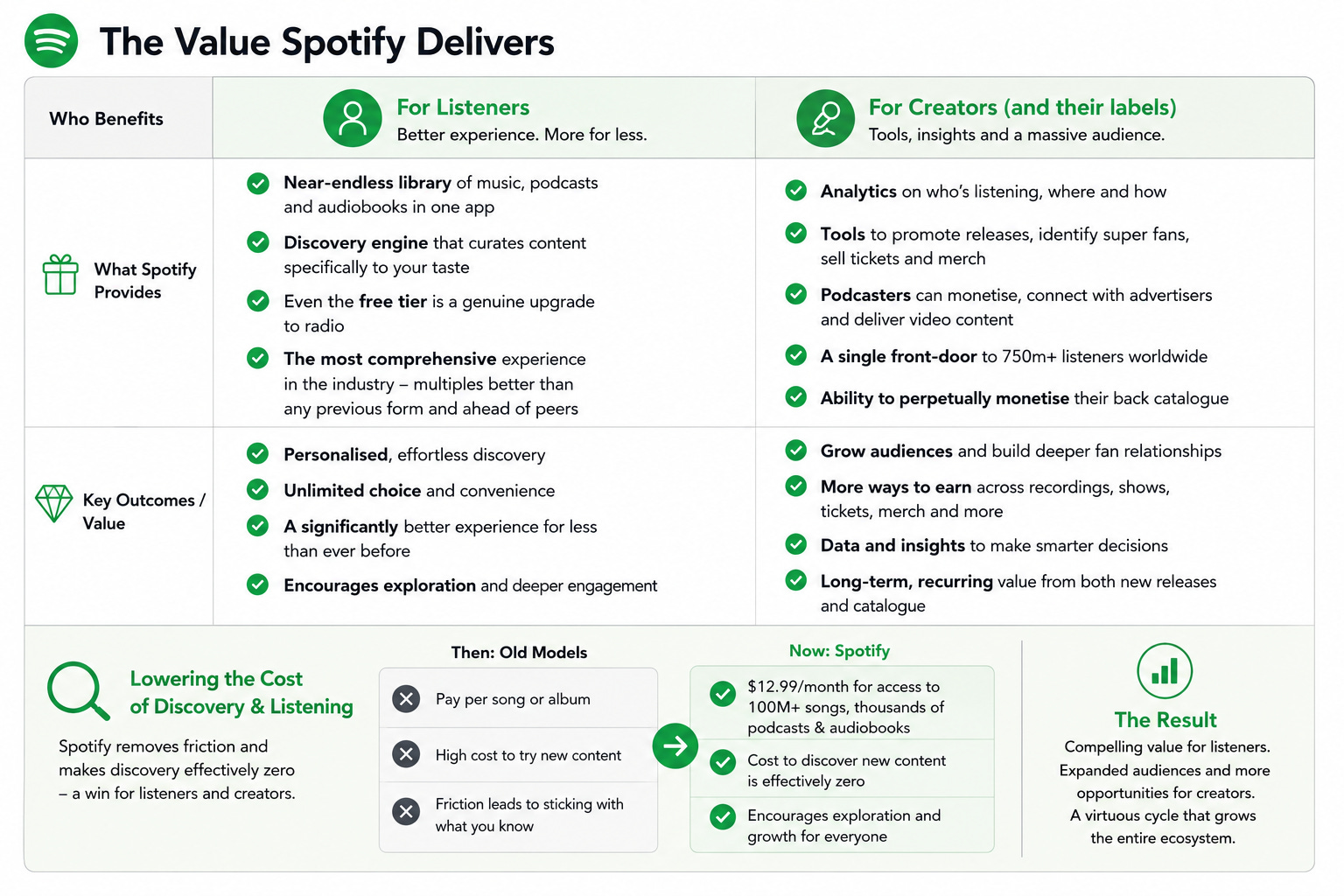
For Listeners – A near-endless library of music, podcasts and audiobooks in one app, surfaced by a discovery engine which curates content specifically to their taste. Even the free tier is a genuine upgrade to radio. The result is an experience that is multiples better than any form the music industry has taken before and more comprehensive than that of its peers.
For Creators (and their labels) – Analytics on who’s listening, where and how. Tools to promote releases, identify super fans, sell tickets and merch. Podcasters get ways to monetise their content, connect with advertisers and now deliver video content. Most importantly, Spotify offers a single front-door to 750m+ listeners and an ability for creators to perpetually monetise their back catalogue.
What’s especially interesting is that Spotify has brought down the cost of discovery and listening to new content to effectively zero. Under previous models, the requirement to purchase new content created friction that prompted listeners to only stick with what they knew or were familiar with. Today, for $12.99 per month, a user has access to 100m+ songs, thousands of podcasts, and audiobooks, which encourages exploration. This is not only compelling value from the user’s perspective but highly beneficial for creators looking to expand their audiences.
This ecosystem advantage compounds and the value each side gets increases as Spotify grows. In the physical and digital era, distribution was a commodity and simply facilitated a transaction. In the streaming era, Spotify manages the relationships between creators and their audiences.
The Habit You Won’t Break
Consuming audio content is largely habitual. My own day is a good example: a workout most mornings accompanied by music, a podcast on the commute to and from the office, and some sort of ambient, low-key music while I’m at my desk. All in, I’m consuming between three to five hours a day of audio content on Spotify. The app is therefore deeply entrenched in my daily routine such that I cannot imagine a day without it.
Human nature is generally averse to change and when people architect their daily lives around a product or service, the incentive costs are higher. This is why people rarely switch bank accounts (when it’s easy to do so) even though they are being subject to low interest rates on balances and high fees.
For many people across the globe, and particularly in markets such as the US, Australia, UK, Spotify is the default interface through which they interact with music and audio content. The more they use it, the stickier it is. Spotify’s first mover advantage in these large developed markets has been real in establishing a loyal base of customers.
In the same vein, the company is expanding aggressively in nascent markets like Brazil and India. The idea here being that they acquire customers through a compelling free tier, build habits and then monetise that relationship further through premium conversions over time. These may be low value customers today, where churn rates are higher and ARPU is lower. But it represents a huge funnel of potentially valuable customers five to ten years out.
Another important point, related to habit is social cohesion. Adding social features to its platform such as Spotify Wrapped, shared playlists, Jams, Spotify Blends, and the Family Plan, encourages adoption within tightknit social circles. People tend to follow the advice of those closest to them and generally don’t like being outsiders. As such, being outside the Spotify ecosystem, when your peers are within it, levies social costs that most people are unwilling to shoulder.
It might be challenging to underwrite human psychology into an EPS forecast, but it’s a powerful force which creates real hurdles to well-capitalised peers gaining share.
Conclusion
So, will Spotify’s fate mirror that of Dropbox? I clearly don’t believe so.
Dropbox’s access layer was ultimately replicable. A folder in the cloud is a folder in the cloud, and once Microsoft and Google bundled the same thing in for free, the reason to pay evaporated. Spotify is a different animal. Its personalisation engine compounds with every stream, its ecosystem sits between creators and their audiences rather than merely shuttling content between them, and habit has quietly woven the app into hundreds of millions of daily routines. None of those are things a competitor can bundle their way past.
Trading at roughly 32x forward earnings, Spotify isn’t exactly cheap. However, if we assume the business continues to compound its earnings at a high-teens rate, the stock should roughly double by 2030 with no help from the multiple at all. There may be some risk with valuation, but investors are being well compensated with the quality of the franchise you receive for the price. Whilst many see a narrow moat around a simple app, I see one of the widest moats in the media industry, getting wider. We can settle the debate over lunch in 2030.
If you’d like to get in touch with me please email me at moatsandmultiples@gmail.com